The Doorway to Future in Computing – What is Quantum Computing?
By definition Quantum computing is the study of a non-classical model of computation. Quantum computers perform operations on data using ideas from quantum mechanics, such as superposition and entanglement.
Too much theoretical, eh?
Don’t worry, we will break it down to simpler terms and understand the basics blocks of quantum computing.
Firstly let’s see what kind of computing we currently have and what is the need to move on to something like quantum computing.
Brief Summary of How Classical Computers Work
A computer chip has basic modules (example for addition ,multiplication etc.) which in turn have logic gates and the logic gates contain transistors.

A transistor is basically a switch which blocks or open the way for the information coming through.
This information is made up of bits which can be set to 0 or 1. Combination of these bits are used to represent any complex set of information.
Logic gates are made up of multiple transistors to do some simple stuff (like an OR gate passes the information only if any one of its input is 1). These logic gates combine to form modules, which can be used for addition , multiplication etc. And combination of these modules can hence do any arithmetic or computation.
Okay cool, so if this is working so well, why do we need something like quantum computers? What are the challenges going forward with classical computing?
Lets try to understand the problem with the classical computation.
As of now a typical transistor can be as small as 14nm (To give you a feel of its size, its 500 times smaller than a red blood cell!!).
As the size of transistors goes on decreasing we will reach a point where the transistor will not be able to stop electrons from passing it. This happens due to quantum mechanical phenomenon called quantum tunneling.
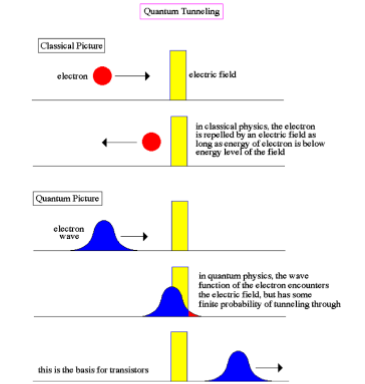
Soon we will be reaching a technological barrier and we won’t be able to reduce the size of transistors. This is the reason there is so much research and demand for quantum computing.
How Do Quantum Computers Work?
A classical computer uses bits but a quantum computer uses qubits.
Qubits can be any two level quantum system, for example spin and magnetic field. 0 or 1 are this systems possible states, but in the quantum world qubit need not be any one of the states but it can be any proportion of these two states at the same time. This phenomena is called superposition.
But as soon as you test its value, it has to be either of the two states. So as long as a qubit is unobserved it is in a superposition of probabilities between 0 and 1 and you can’t predict which it will be, but the instant you measure it, it collapses to one of the two states (like the Schrodinger’s cat).
If you are wondering how all of this is helpful, here it is:
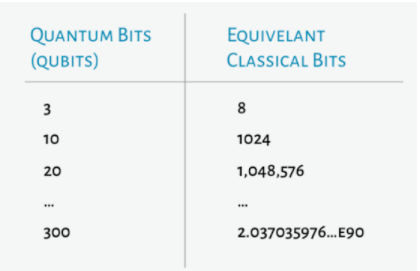
If you consider 4 classical bits, it can be in 24=16, different configurations at a time, out of which you can use only one.
However 4 qubits in superposition, can be in all of those 16 combinations at once!. This number will grow exponentially with increase in number of qubits.
Twenty qubits can store a million values.
Another weird property that qubits have is entanglement. Entanglement is basically a close connection between the qubits that make each of the qubit react to a change in the other’s state instantaneously, no matter the distance between them.
What this means when measuring one entangled qubit you can directly deduce properties of it’s partners without checking them. Now we know what qubit is, lets see how we can do qubit manipulation.
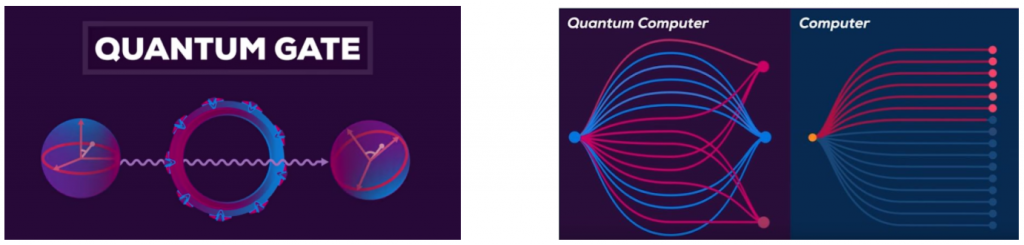
A classical logic gate takes a set of inputs and produces one definite output, where as a quantum gate manipulates an input of superpositions, rotates probabilities and produces another set of superposition as its output.
So here we are, finally!
A quantum computer sets up some qubits, applies quantum gates to entangle them and manipulate probabilities and finally measures the outcome collapsing to an actual sequence of 0s and 1s.
What this allows you to do is, you can get the entire calculations that are possible with the setup done simultaneously.
Though the quantum computers may not replace our personal computers, in the areas like database searching, they are vastly superior. A quantum computing algorithm takes around square root of the time required using classical computing!
Quantum Supremacy
What did Google achieve?
Recently Google declared that it had achieved ‘Quantum Supremacy’.
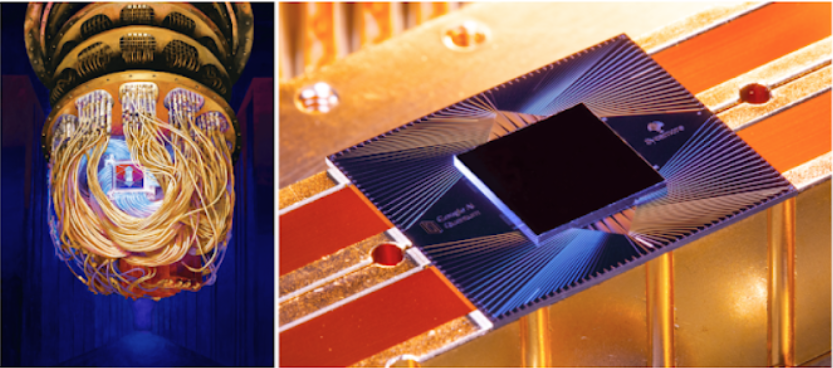
Google developed a new 54-qubit processor, named “Sycamore”, that is comprised of fast, high-fidelity quantum logic gates, in order to perform the benchmark testing. in order to perform the benchmark testing.
Google claims that their quantum computer(Sycamore) has solved a problem that would take the best computer in the world to solve 10,000 years in just 3min 20sec.
In the experiment, google ran random simplified circuits from 12 up to 53 qubits, keeping the circuit depth constant and checked the performance of the quantum computer using classical simulations and compared it with a theoretical model. Once it was verified that the system was working, they ran random hard circuits with 53 qubits and increasing depth, until reaching the point where classical simulation became infeasible.
Threats to Cybersecurity
Quantum Computing can be a potential threat to cybersecurity. At present your browsing, email and banking data is being kept secure by an encryption system in which you give everyone a public key to encode messages only you can decode.
This public key can be used to calculate your secret private key. But doing this on a classical computer by trial and error will literally take thousands of years. But a quantum computer exponentially speeds up the process and does it very quickly.
All in all Quantum computing opens up a lot of different fields going forward and is definitely going to be the doorway to the future in computing and technology.
– An article by Subham Mohapatra, 3rd Year Electrical and Electronics Engineering.