Eliud Kipchoge, the world’s most celebrated long-distance runner, broke the marathon record last year. Not only did he break his previous record, but also completed it in under 2 hours, something which was deemed impossible by most experts. One could say that it was Nike that made this happen.
Nike, partnered with Kipchoge and Dr. Rodger Kram from the University of Colorado, whose field of expertise is bio-mechanics. After months of testing in the labs, Nike manufactured the ideal marathon shoe- The Vaporfly.
The Vaporfly is a unique shoe, with a sole thicker than traditional marathon shoes. Many runners accused Nike of ‘mechanical and technological doping’. Let us take a deeper look into its structure.

The sole is made up of a special polyurethane foam known as ethylene-vinyl acetate (EVA) co-polymer. The specialty of this polymer is the ability to undergo extensive bonding. It has an elastomeric behaviour and hence is also used in the manufacture of a hydro-gel. EVA is a known shock absorber. The EVA that Nike used was a specially designed foam, which is a guarded corporate secret. The new foam has high resilience and dissipative power. The polymer matrix somehow has a dissipative power of almost 85%. A special fabric was used to weave the shoe, which reduced the weight of the shoe by a huge margin.

To add to this, a carbon fibre plate was introduced between the foam and the fabric. The main purpose of this was to allow it to act as a lever and produce torque, to assist ankle movement. The net energy efficiency of the athletes was found to be 4%. This is a significant difference to achieve the pace required to take down that record.
Another important technique that was researched to help Kipchoge achieve this record was related to aerodynamics. Drafting is a tactic employed in many sports. This technique allows competitors to conserve energy by using the wake created by other athletes to pull them along. The wake provides a favorable pressure gradient to the trailing athlete. Since the pressure is low in the wake, the athlete is pushed along by the atmospheric pressure behind them. While drafting is frequently used in high-speed sports, such as auto racing or bicycling, it is also an effective technique in low-speed sports, such as marathon running.
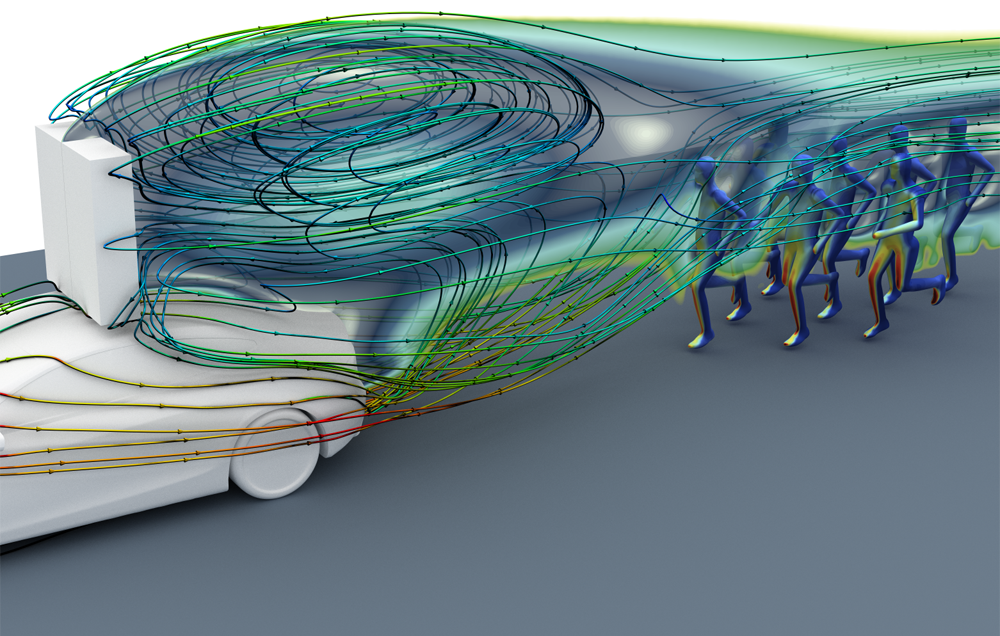
After detailed research and CFD modeling, the best formation to run to maximize the effects of drafting was the arrowhead position, with the chief runner placed in the centre of this formation. This is shown in the image below:

In the image below, we observe the CFD model of airflow in drafting. It looks as though the pace car makes a difference in airflow, but in reality, the airflow returns to normalcy when it reaches the runners. The pace car is said to have reduced at the most 15 seconds.
Sports and Science have always had a healthy relationship. Eliud Kipchoge benefited heavily from material sciences, bio mechanics, and fluid dynamics. This application of modern scientific and engineering techniques has changed the face of sports for a long time to come.
– Article by M. Bharadwaj, 3rd year Metallurgy and Material Science Engineering