
Have you ever wondered, how huge and bulky computers, of the size of an entire room, transformed into a much portable laptop? How have the fast processors evolved over a few years? Today’s smartphones are considered supercomputers. This lays a base for Moore’s law. This advent of technology is due to the number of components doubling every two years. But what will happen if we run out of space on the chips, which of course will eventually be the case in the next few decades?
So, to keep advancing in technology, alternatives are to be explored. With that in mind, scientists and researchers try to change the ingredient of the computer. The answer lies in optics. Many of us are familiar with the optical fibers through our +2 years and their advantages over electrical cables. Optical computing is the next era of computers. Just imagine the speed of light and its stability towards electromagnetic radiation. The energy will be required only to generate laser light, and hence it will be energy efficient.
THE NEED FOR IT
The need for optical computing is rising. As we know, metallic wires limit the transmission and coming to the Moore’s Law, it’s not a law, rather, an observation realized during the 1970s. So far, though the component cost is decreasing due to miniaturization, the expenses for the research for the further improvement and tests is increasing and is referred to as Moore’s Second Law.
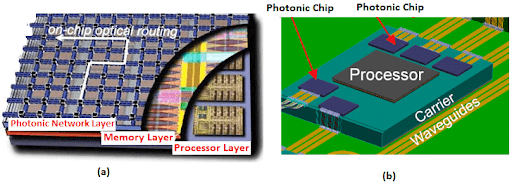
Though it is in preliminary stages, optics has already made its step in digital communications, because of its lower attenuation and can carry a large amount of data, without any electromagnetic interference. Though completely optical computers might not be possible soon, we can have something like the electro-optical hybrid model. Here, the communication can be handled by the photons. In recent years, optical logic gates and memory have also been designed. This shows the ability of optics to emerge shortly.
IS IT FEASIBLE?
In optical computers, light replaces electricity, to compute various operations. Since the photons have quite different properties than electrons, we can expect various advantages, though some challenges are required to be tackled. So, instead of having a pure optical model, electro-optical hybrid devices are used in which electrons and photons both take part. The hybrid computers have their parts realized using optical technology in the presence of the necessary existing electronic parts.
Now let’s focus on the technical aspects.
OPTICAL COMPONENTS – AN ANALOGY WITH ITS ELECTRONIC COUNTERPARTS
Analogous to electronic transistors, there is a need for optical transistors serving the same purpose. For this, we require two individual light beams to interact and produce a resultant beam, which is possible only in the presence of electrons possessing high energy. Implementing this is one of the significant challenges of purely optical transistors that are yet to overcome. These optical transistors are the fundamental units that make up the processor or CPU. Also, there here has been the development of holographic memory, responsible for the storage of data. These transistors, holographic memory, and optical fibers form the optical components, some of which have already been manufactured, however, we would have to wait for the optical computers to surface.

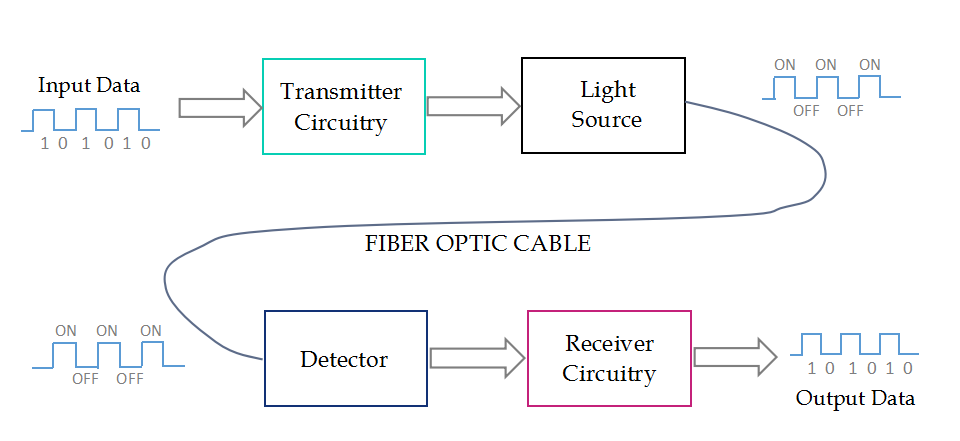
In the hybrid device, electronic parts are used for reading the data. After the data is encoded it is transferred via light pulses. After reaching the destination, the data is transformed back into binary. Researchers from various universities like MIT and Aarhus University are trying to write and read binary data through laser light.
With the advent of hybrid electro-optical computers, although speed has been compromised, still it possesses a good potential for further improvement. As every technology emerges and advances through its difficulties, it is natural to expect the challenges of high energy requirements that optical computers may bring along with, and there is a hope that our existing technology advances itself.
– Dipanshu Barnwal
Great job
Thank you for your appreciation