The age of electrically-based devices has been with us for more than six decades. With more and more electrical devices being packed into smaller and smaller spaces, the limits of physical space will prevent further expansion in the direction the microelectronics industry is currently going. Also, volatile memory, which does not retain information upon being powered off, is significantly hindering ultrafast computing speeds. However, a new breed of electronics known as spintronics can completely change that.
Spintronics also known as spin electronics is an emerging field for nanoelectronics that exploits the spin of electrons and magnetic moment along with the electronic charge. Spintronics has proved to be very efficient in nanoelectronics as it consumes less power and has much better memory and processing capabilities. Spintronics fundamentally differs from traditional electronics in that, in addition to charge state, electron spins are exploited as a further degree of freedom, with implications in the efficiency of data storage and transfer.
Instead of solely relying on the electron’s negative charge to manipulate electron motion or to store information, spintronic devices would further rely on the electron’s spin degree of freedom. Since an electron’s spin is directly coupled to its magnetic moment, its manipulation is intimately related to applying external magnetic fields. The advantage of spin-based electronics is that they are very non-volatile compared to charge-based electronics, and quantum-mechanical computing based on spintronics could achieve speeds unheard of with conventional electrical computing.
Spin Hall effect
In order to realize spintronics as a fully operational technology, the ability to manipulate spin-polarized electrons within a conductor is necessary. A phenomenon called the spin Hall effect may be the solution. In the regular Hall effect, if a magnetic field is placed perpendicular to the direction of current flow in a conductor, a bias voltage will be created perpendicular to both across the conductor. The reason for this is the electrons in the current interact with the magnetic field and experience a Lorentz force at right angles to the field and direction of current flow. They are pushed to one side of the conductor, and an electric field is created across the conductor. In the spin Hall effect, a similar phenomenon occurs. Because the spin of an electron is coupled to its magnetic moment, if an electric field is placed perpendicular to the direction of current flow, the electron’s spin degree of freedom interacts with the field and also experiences a Lorentz force. However, since electron spin can point either up or down, the two types of electrons will separate and move to opposite sides of the conductor.
Application of spintronics in memory
Most modern hard disk drives employ spin-valves to read each magnetic bit contained on the spinning platters inside. A spin-valve is essentially a spin switch that can be turned on and off by external magnetic fields. Basically, it is composed of two ferromagnetic layers separated by a very thin non-ferromagnetic layer. When these two layers are parallel, electrons can pass through both easily, and when they are antiparallel, few electrons will penetrate both layers. generally, an electron current contains both up and down spin electrons in equal abundance. When these electrons approach a magnetized ferromagnetic layer, one where most or all contained atoms point in the same direction, one of the spin polarizations will scatter more than the other. If the ferromagnetic layers are parallel, the electrons not scattered by the first layer will not be scattered by the second and will pass through both. The result is a lower total resistance which means higher current. However, if the layers are antiparallel, each spin polarization will scatter by the same amount, since each encounters a parallel and antiparallel layer once. The total resistance is then higher than in the parallel configuration which means the current is comparatively lower.
Thus, by measuring the total resistance of the spin valve, it is possible to determine if it is in a parallel or antiparallel configuration, and since this is controlled by an external magnetic field, the direction of the external field can be measured. Since each bit in a hard drive either points in one direction or the other, their orientation can easily be determined with a device using this mechanism.
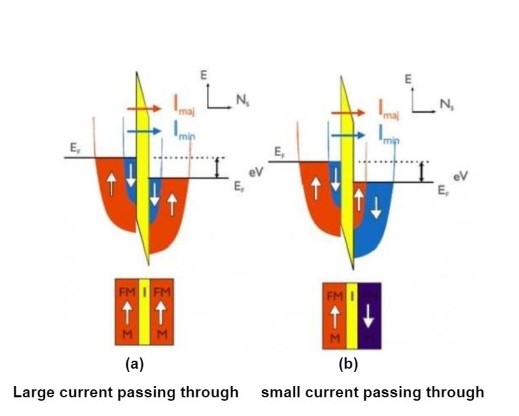
When a current of electrons passes through a magnetized ferromagnetic layer, it becomes spin-polarized in one direction, much like the polarization of light through a filter. When a current of electrons gets spin-polarized by a ferromagnet, a small transfer of angular momentum happens between the current and the magnet, this is known as the spin torque effect.
Magnetic transistor
The problem with electrically-based transistors is their volatility. When power is shut off, the electrons in the p-type semiconductor are no longer confined to a single region and diffuse throughout, destroying their previous on or off configuration. This is the reason why computers cannot be instantly turned on and off. However, a new type of transistor may change all of this. In a magnetic transistor, magnetized ferromagnetic layers replace the role of n and p-type semiconductors. Much like in a spin-valve, substantial current can flow through parallel magnetized ferromagnetic layers. However, if, say, in a three-layer structure, the middle layer is antiparallel to the two outside layers, the current flow would be quite restricted, resulting in high overall resistance. If the two outside layers are pinned and the middle layer allowed to be switched by an external magnetic field, a magnetic transistor could be made, with on and off configurations depending on the orientation of the middle magnetized layer.
With a growing demand for faster and faster processing and more memory in the smallest space possible, spintronics is the technology for the future. This technology will help us take a big leap forward towards faster and better electronic devices.
– By Harshit Kumar, Third Year Department of Electrical and Electronics Engineering