Scientists have warned about ‘Code Red’ for humanity. But how long do we have before it’s too late?
Governments and many organizations have set guidelines to commit to climate neutrality. The Global Carbon Project, one such organization, aims to stop the increase in greenhouse emissions by 2050. This project has focused the attention of the scientific community, policymakers, and the general public on the rising atmospheric concentrations of the three main greenhouse gases, carbon dioxide (CO2), methane (CH4), and nitrous oxide (N2O).

Most of the responsibility has been put on engineers for bringing solutions to achieve a net-zero carbon economy. Global corporations are responsible for an alarming share of emissions, which places them in the crosshair of industry regulators, journalists, and environmentalists. In the future, these corporations will be judged even at stock exchanges based on their low carbon portfolio!
Even though carbon emissions decreased by up to a third during the global COVID-19 lockdowns, it can’t be assumed as a continuing trend ahead. Annual cuts of 1-2 billion tonnes of CO2 are required throughout the 2020s and beyond to avoid exceeding global warming within the range of 1.5°C to well below 2°C, as per the UN Paris Agreement.
Some of the mandates according to the Global Carbon Project include:
- To synthesize current understanding of the global C cycle and provide rapid feedback to the research and the general public.
- To develop tools and conceptual frameworks to couple the biophysical and human dimensions of the carbon cycle.
- To develop a small number of new research initiatives that are feasible within a 3-5 year time framework on difficult and highly interdisciplinary problems of the carbon cycle.
- To support and foster carbon research in regions (e.g., tropical Asia) that will provide better constraints of continental and global carbon budgets.
Every phase of the engineering sector needs to adopt a net-zero carbon impact on the world in terms of construction, chemicals, etc., ensuring no negative side-effects to any process. The SUN-to-LIQUID project at ETH Zurich created solar kerosene from water, CO2, and the sun rays, creating a breakthrough in the field of fossil fuel energy. Negative emissions technology (NET) will also play a big part in achieving climate targets, leading to a negative balance of carbon in the atmosphere. Projects and funding need to be handled in such a way that there is an incentive for engineering companies to collaborate and tackle the big problems. Investments need to be targeted to achieve the most impact to hit the 2050 target.
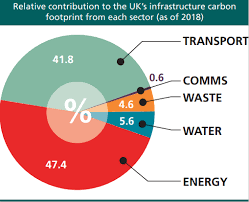
The impact of low-carbon design is generally increased with a project’s magnitude and longevity. And because the heavy proportion of carbon is generated by user behavior, project design that encourages less carbon-wasteful behavior has a huge impact.
With this in mind, the most effective solution may be not to build but just analyze and improve. Commitment to a carbon zero future means investigating alternative scenarios that involve re-use, adaptation, and a possibility of behavioral change that will eventually reduce the need for the asset.
Twenty-nine years from today, if every sector plays its part, there can be a carbon net-zero economy and changes in lifestyle that seem unimaginable now to everybody will themselves be routine.
– By Dhriti Ravi Kanchan, Third Year Department of Civil Engineering