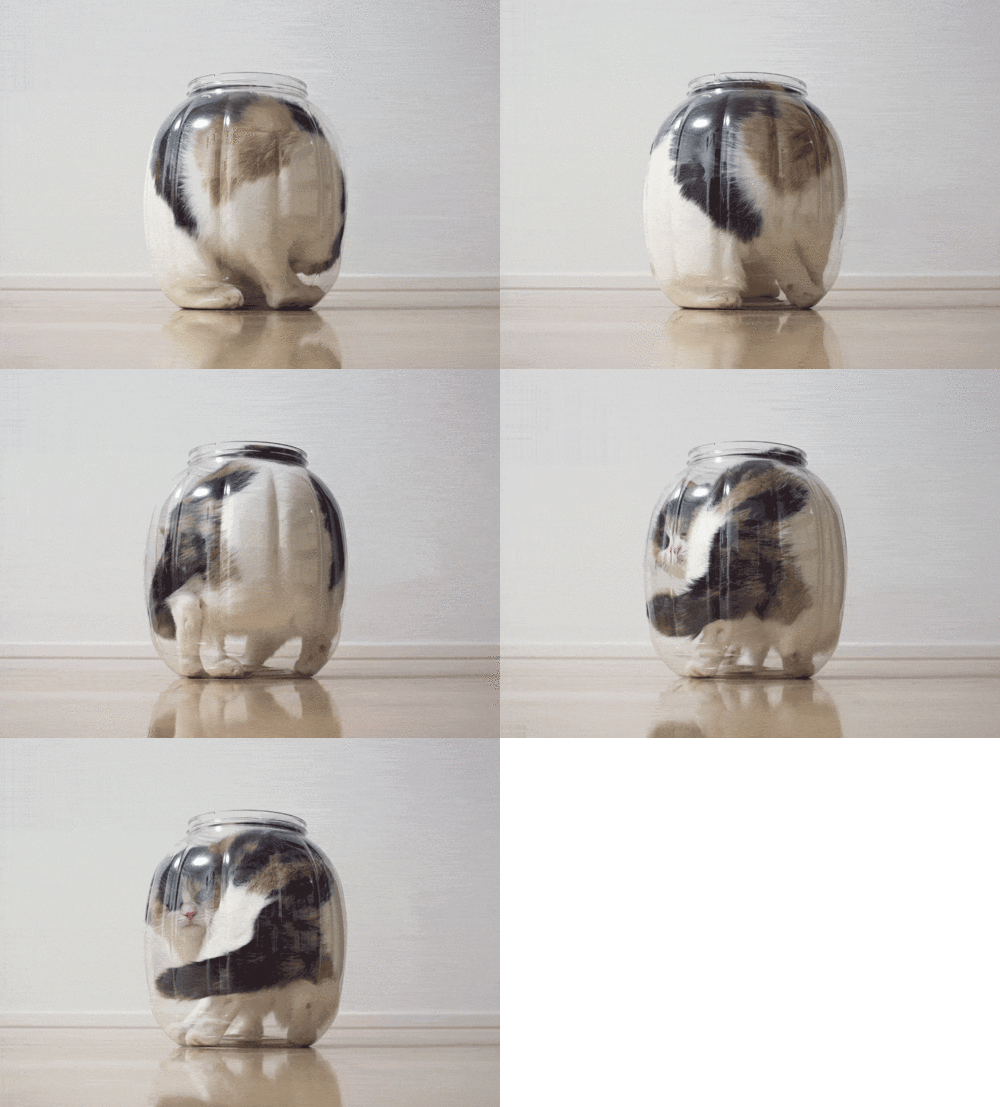
Haven’t we all seen the galore of ultra cute pictures of cats on social media? A somewhat paradoxical observation that emerged on the web a few years ago is how our feline friends seem to fit into anything they decide to sit in, from a fishbowl to a sock. Antoine Fardin pondered over this and the result fetched him the Ig Nobel Prize for Physics in 2017.
The Ig Nobel prize began in 1991 by Marc Abrahams, editor and co-founder of the Annals of Improbable Research. Ten prizes are awarded every year to unusual or trivial work in scientific research, with the aim of shining a light on achievements that first make people laugh, and then make them think.
In his study ‘On The Rheology of Cats’, Antoine Fardin uses fluid dynamics to probe the question “Can a cat be both a solid and a liquid?”. Rheology is the study of deformation and flow of matter. At the centre of the definition of a liquid is an action: A material must be able to modify its form to fit within a container. The action must also have a characteristic duration. In Rheology, this is called the relaxation time. Determining if something is liquid depends on whether it’s observed over a time period that’s shorter or longer than the relaxation time.
Taking the example of cats, the fact is that they can adapt their shape to their container if given them enough time. Cats are thus liquid if we give them the time to become liquid. In Rheology, the state of a material is not really a fixed property – what must be measured is the relaxation time. What is its value and on what does it depend? For example, does the relaxation time of a cat vary with its age? (In Rheology, this is called Thixotropy.) Could the type of container be a factor? (In Rheology this is studied in “wetting” problems.) Or does it vary with the cat’s degree of stress? (“shear thickening” if the relaxation time increases with stress, or “shear thinning” if the opposite is true.) Of course, we mean stress in the mechanical sense rather than emotional, but the two meanings may overlap in some cases.

Determining the state of a material requires comparing two time periods: the relaxation time and the experimental time, which is the time elapsed since the onset of deformation initiated by the container. For instance, it may be the time elapsed since the cat stepped into a sink. Conventionally, one divides the relaxation time by the experimental time, and if the result is more than 1, the material is relatively solid; if the result is lower than 1, the material is relatively liquid. This is called the Deborah number, after the biblical priestess who remarked that on geological timescales, even mountains flowed.
Even if the relaxation time is very large (days, years), the behaviour can be that of a liquid if the Deborah number is small (compared to 1). In Rheology, and in science more generally, there are many dimensionless numbers that can be used to determine the state or regime of a material or system. For liquids, there is another dimensionless number that can be used to estimate whether the flow will be turbulent, with vortices, or whether it will calmly follow the outline of the container (laminar). Comparing this duration and the relaxation time produces the Reynolds number in the case of fluids dominated by inertia (like water), or the Weissenberg number for those dominated by elasticity (like cake batter). If these dimensionless numbers are large in comparison to 1, then the flow is likely to be turbulent. If they’re small in comparison to 1 the flow is likely to be laminar. Fardin observes that defining this number for cats is challenging since they are ‘active materials’.
Fardin uses wit and humour to illustrate the use of dimensionless numbers in Rheology. Find the entire paper at: https://www.drgoulu.com/wp-content/uploads/2017/09/Rheology-of-cats.pdf
– Deeksha Hegde