VTOL stands for “vertical take-off and landing.” As the name implies, it denotes a kind of aircraft that can launch and land from a single spot. Since aerial vehicles equipped with VTOL technologies don’t require the horizontal space of a runway, they can start and end from virtually any location on the globe.The idea of vertical flight has been around for thousands of years and sketches of VTOL (helicopter) shows up in Leonardo da Vinci’ s sketch book.They could take-off from a ship, pick up passengers waiting in a forest clearing or a city parking garage, and come to rest on top of a building. The number of potential combinations is nearly infinite.
At its core, the science that governs VTOL aircraft is the same science that regulates traditional aerial vehicles. All flying machines operate by generating lift, which is the force that counteracts the weight of the aircraft in question. To get a little more technical, lift is the force that is produced when a solid body (such as a wing, blade, or jet nozzle) changes the direction of the air that it encounters. As air is turned, lift is generated in the opposite direction, causing the aircraft to rise. There are two different types of VTOL technology: rotorcraft and powered-lift.
Rotorcraft: helicopters, quadcopters
The rotorcraft, or rotary wing aircraft, generates vertical lift using blades that revolve around a central mast. A number of blades mounted on a single mast are referred to as a “rotor,” hence the name “rotorcraft.” A helicopter’s blades are curved on top and slightly flatter on the bottom. This shape makes the airflow over the top of the blade faster than the air flows under it. This is where something known as Bernoulli’s principle comes into play. Ultimately, this principle describes how the speed of air and pressure of air are related. In short, when a helicopter’s blades rotate, there is less air pressure on top of the blades, which causes suction and makes the aircraft rise. Notably, rotorcraft depend on their rotors to sustain their lift throughout the duration of their flight. This is ultimately what separates them from the other major classes of VTOLs.
Powered-lift: convertiplane, vectored thrust vehicles
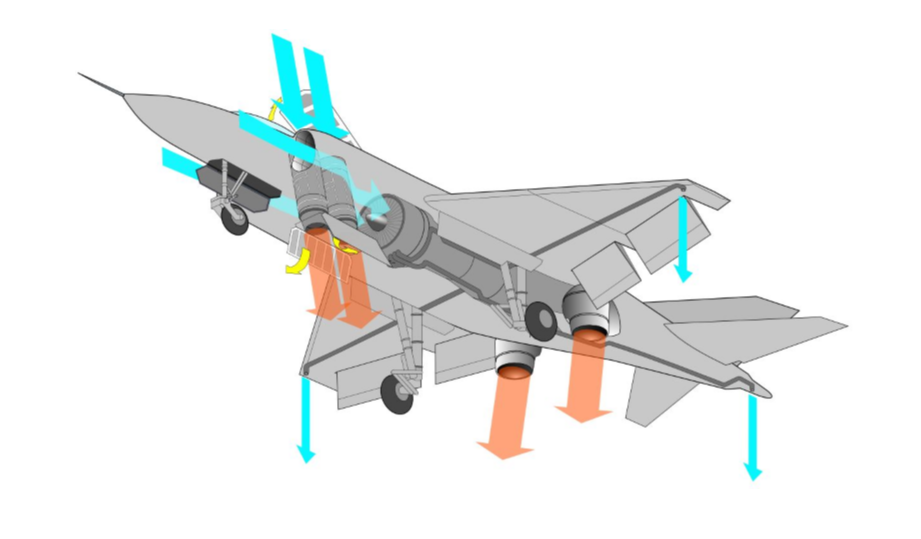
Powered-lift vehicles are aircraft that take-off and land vertically and depend primarily on non rotating devices (fixed wings) to sustain their lift during horizontal flight. Such aircraft may, however, deploy rotors to drive their lift during their launch and landing operations. Powered-lift vehicles are aircraft that take-off and land vertically and depend primarily on non rotating devices (fixed wings) to sustain their lift during horizontal flight. Such aircraft may, however, deploy rotors to drive their lift during their launch and landing operations.
– Punit Chauhan