Atham, Chithira, Chodhi, Vishakam, Anizham, Thriketa, Moolam, Pooradam, Uthradom, Thiruvonam. Ten days, one massive festival. From pookkalams (floral carpets) to sadhyas (feasts) to snake boat races to native art forms to processions to games and gifts, Onam is certainly celebrated with much fanfare by the worldwide Malayali diaspora. Although it has its roots in Hindu mythology, Onam has no explicit religious connotation. It is an occasion for joy, compassion, gift-giving and solidarity, and embodies Kerala’s cultural unity and pluralism.
But behind all the feasts and festivities, the origin of Kerala’s beloved harvest festival is a story to be told. Legend has it that God’s Own Country was once ruled by an Asura king Mahabali under whom Kerala knew neither hunger nor sorrow. Envious of his growing reign, the Devas schemed to end Mahabali’s rule. Initially not too keen on joining in the violence against a devotee, Vishnu set out to test Mahabali’s generosity and temperament. He visited Mahabali as a poor Brahmin dwarf, Vamana and asked for a seemingly simple gift – land, the amount he could measure in no more than three paces. The amused king agreed and Vishnu proceeded to increase his stature to cosmic proportions and the ‘little Brahmin boy’ covered the whole of the heavens, blotting out the stars with one step, and straddled the netherworld with his second. Awestruck, Mahabali realised that his third step would destroy the world, and offered his head as the final, fatal step that would banish him to the netherworld. But moved by his integrity, Vishnu granted his request to be allowed to return once a year, thus giving rise to the ten-day long festivities of Onam, when a grateful Kerala pays a glorious tribute to the memory of a benign king who gave his all for his subjects.
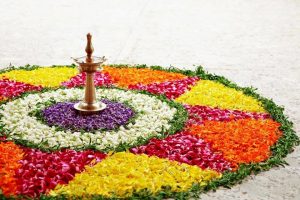
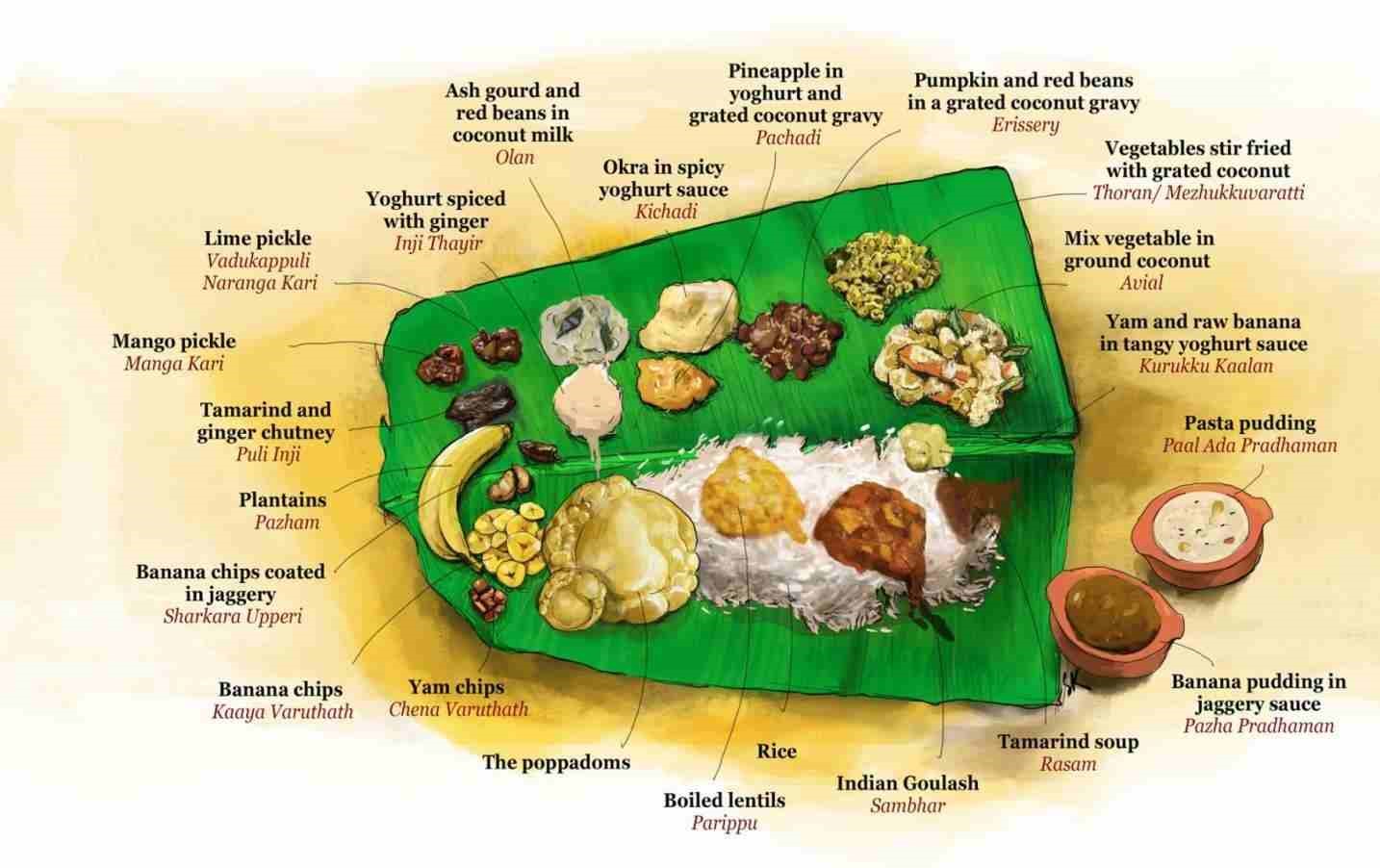
Adding to the significance of the festival is its place as a harvest festival that also marks the start of the New Year as per the Malayalam calendar. One of the most impressive and striking parts of Onam is the Onasadhya or the Onam feast. Although the traditional sadhya is a nine-course vegetarian meal laden with as many as twenty-six different delicacies, as much as 10-13 dishes are included by families, to make it as feasible and as grand as is possible. Another remarkable aspect is the floral carpets, that are laid from the first day and with each passing day, the size of the pookkalam increases with the addition of flowers. Thousands of domestic and foreign tourists visit Kerala during this festive period to take part in the celebrations.
Onam has been an integral event in my life, starting from my early days in the Middle East. It was that period of the year when I was closest to my Malayali roots. Tripping on my little mundu, spilling paayasam all over my kurta and messing up the colours on the pookkalam were just some of the highlights of my early Onam celebrations. But that just offered me a small glimpse to the whole plethora of festivities accompanying it. Although events at my school back in Kerala did offer a different perspective, it was after I reached college that every aspect of Onam opened up in front of me, perhaps in a manner much more defined than one I’d witness back home.
When you’re a first-year, grappling with all the novelties, trying to make friends and settle down as quickly as possible, nothing makes you feel at home more than working with a group of people to organize an event that means a lot to you. You’d expect disparities to exist between the new kids and the older ones, and for a large part, they did. But as the spirit of Onam took over, the divide between seniors and juniors began to fade, the energy of the group seemed to increase with each passing moment, spreading infectiously to the few whose hearts weren’t racing yet. I was overwhelmed by the sense of brotherhood and love that had taken me in and made me feel quite at home. I realised that Onam was just an excuse to bring people together, away from their mundane daily routines, so that they can take part in this joyous occasion. As first years, we couldn’t help with planning, but we could help with the execution of our third years’ meticulous plans, and we did. We weren’t alone as they were present alongside us at every step, working harder than we did. From organising programs in the SJA to helping out in the kitchen to bringing the food into campus to serving and cleaning up later, it was one non-stop rollercoaster of a day, at the end of which there was a sense of satisfaction laced with a tinge of sadness brought in by the realisation that we’d have to get back to our usual routines soon.
Every year, the sense of excitement and anticipation surrounding Onam has only grown, and as we go about with the preparations for this year’s event, as the responsibilities shift into our shoulders now, I realise that the significance of Onam in my heart has grown from a festival celebrated to welcome a mythological character to one that signifies togetherness, love and prosperity. Far from being just a harvest festival, Onam unifies and brings people together like nothing else. And that is why Onam isn’t just a festival that goes on for ten days, it isn’t just about the sadhya or the pookkalam, it’s an inexplicable emotion, one that showcases Kerala in its unified, temporal and vibrant glory.
– Tharfeed Ahmed Unus
Fabulous
Good read…. nice one…keep going