Cryptocurrencies have inculcated themselves into the daily affairs of the common man. The pioneer of cryptocurrencies is the Bitcoin, its fluctuations in price make for an investor’s rollercoaster.
As with all currency in the economy, cryptocurrencies have to be stored somewhere for safekeeping. There are two types of wallets which are used for this:
- Hot Storage Wallets
- Cold Storage Wallets
Hot Storage Wallets
The term ‘hot’ refers to the connection of this wallet to the internet eternally. These wallets are accessible using the internet and support a large variety of cryptocurrencies and are consistently updated. Even transactions occur at a moderate speed vis-a-vis its counterpart wallet type.
However, being in a persistent connection with the internet leaves the wallet bearer susceptible to attacks from hackers online. There have been countless reported instances of the wallet information being compromised and is a risk of using hot storage wallets.
A few popular hot wallets are:
- Coinbase
- Exodus.io
Cold Storage Wallets
In this wallet type, the information is stored offline on a physical device which can be kept in a security box or in a sock drawer if one is feeling adventurous. These devices are protected by a secret key/passcode chosen by the user and used often in the professional sphere.
The cold wallet transactions are quite slow and they do not support a large number of cryptocurrencies. They are priced fairly high ($100 USD is the standard).
A few popular cold wallets are:
- Ledger Nano S
- Trezor.io
An analogy to depict the usage of the two types of wallets is:
A hot wallet is a wallet we carry around with us, it contains enough money to get us through the day, but there are chances of that wallet being stolen. Which is why we’re always told to carry extra money in our right shoe (or is that just me).
A cold wallet represents a bank account containing all of one’s wealth, this means that one’s majority of crypto cash should be on a cold wallet for security. In other words, if you have more than a $100 dollars in crypto cash use a cold wallet as that is its base cost.
The Secret Key (Or the Seed)
The secret key is a necessity for the wallets(particularly cold wallets) to function. Not to divulge very much into the cryptographic algorithms, the secret key is used to create the public and private key pairs. The secret key is usually a string of characters. However, storage of this key is very vexing.
- If it is on paper it can always be lost, damaged or read by others
- If it is on a computer it can always crash and there would be no way to recover the key.
- If it is on hardware such as a USB or a flash drive there are chances of misplacing it or damaging due to atmospheric conditions after a prolonged duration.
To mitigate this, the idea of using DNA as a secret key has been implemented by a company named Carverr, spearheaded by their C.E.O, Vishaal B. Bhuyan.
The Idea
Carverr prides itself over the fact that DNA will never become obsolete. Reading and writing DNA will always be relevant; therefore, there is no need for software patches, updates or new hardware.
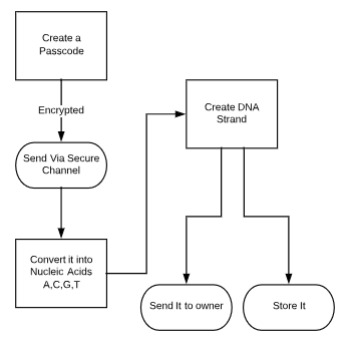
The service requires the customer to send a passcode to them via their secure communication channel and then convert this key into DNA. DNA consists of four nucleic acids adenine(A), cytosine(C), guanine(G), thymine(T). A special algorithm converts the binary codes (0s and 1s) into a string of bases containing As, Cs, Gs, Ts, or in other words DNA. Carverr then manufactures a strand of synthetic DNA, using the string of bases.
This DNA is sent or stored as per the client’s request, the retrieval process for getting the passcode from the DNA takes nearly 3 days. Finally, the decoded passcode is sent back to the client via the same secure channel which was used for sending.
Say one were to forget the decoded secret key, the owner can send the DNA strand back to Carverr and they will decode it for him. These DNA obtaining methods have been around since the 60s. Reading and writing DNA will always be relevant therefore, there is no need for software patches, updates or new hardware
Conclusion
Considering the fact that DNA was identified 6 decades ago, it was quite unforeseen to have such an integration between Biology and Computation. Davos DNA-storage Bitcoin Challenge was conducted in 2015 to see if one could retrieve a passcode from DNA, showing that this idea was in the air for quite a while.
– Hrishikesh Thakkar
Marvelous, what a blog it is! This website presents helpful facts to us, keep it
up.