Electronics and the Human Body were considered to be two independent disciplines on themselves. However, today, things are changing. These two are being integrated into each other. With the advancement of silicon technology, electronic engineers are exploring new possibilities like the ones below:
Edible Electronics
The truth is, electronics, in general, aren’t designed to be eaten. They often have indigestible or even toxic materials inside them. They can cause serious damage if they get stuck inside you, but researchers all around the world are working to change that. Yes, there is actually a field of research called Edible Electronics. So why would you ever want to swallow electronics in the first place? One reason is medical imaging. There’s a process called Capsule Endoscopy in which you would swallow a small camera inside a plastic capsule, and it would take pictures of your G.I. Tract as it passes through your system. That would mean a doctor wouldn’t have to insert a tube into one end or the other or perform abdominal surgery.
But there are alternative applications as well, such as authentication. A couple of years ago a Motorola project leader actually suggested creating password pills. Imagine being able to log in securely to any device because you swallowed an e-verification pill that morning rather than having to type in a password.
Every year thousands of people around the world accidentally swallow button batteries. Often these batteries just pass through our digestive system without any problem, but sometimes they can become embedded in various tissues like the inner lining of our stomachs, and that can cause serious internal damage.
But what if a child accidentally swallowed such a battery could then take a pill containing a robot to remove that battery? Daniela Rus and other researchers at MIT have been working on a concept called Origami Robots. These are robots that are folded up into a tiny shape and can unfold when subjected to a particular stimulus like an electric current or a change in temperature. By unfolding and folding repeatedly, these robots can crawl or swim, and in 2016 these researchers from MIT along with others from the University of Sheffield and Tokyo Tech demonstrated that they could use such a robot in a simulated human system: An oesophagus and stomach.
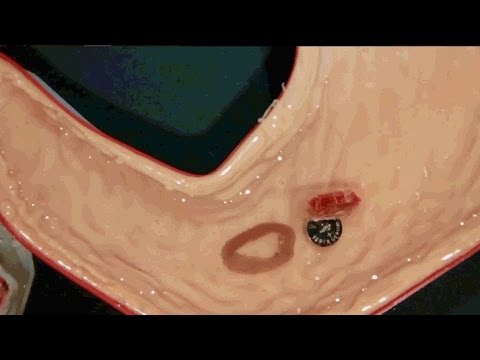
It can be a challenge to make edible electronics since certain components tend to have really unfriendly stuff in them, particularly batteries and power sources, but that’s beginning to change too. Carnegie Mellon professor Christopher Bettinger has been studying edible electronics for a few years, and his research team has created a battery with an anode made out of Manganese Oxide, which is a mineral, and a cathode made out of Melanin, that’s the pigment found in skin and hair. This particular device could use liquids inside the body such as gastric fluid to act as an electrolyte to carry current between the anode and the cathode, and in the lab, they have demonstrated that this could create the power of five milliwatts for up to 20 hours.
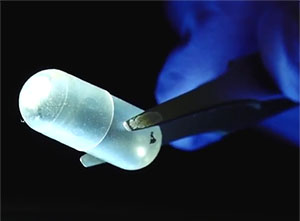
Imagine a far-off future where you could even take something like a tiny surgical robot that could perform a procedure and then pass through your digestive tract, or perhaps a drug delivery robot that could travel to a specific location in your digestive tract and release medication at the right time and place.
Electronic Skin
The first computers were pretty big. They were made out of enormous components. And computer scientists of the day thought that the more advanced computers of the future would be even larger. They didn’t foresee the development of the transistor and the era of miniaturization, so they would’ve been blown away by the idea of electronic skin.So, what is electronic skin? Well, it’s thin, flexible circuitry that can actually be put on a pad that can stick to your skin and monitor things like your vital signs. John Rogers, a pioneer of this technology, showed off examples a few years ago.

They were thinner than a human hair. They could bend, they were flexible. They could stretch well beyond their original size and still work. And they could adhere to your skin without any sort of glue on them through the Van der Waals force. The components on these circuits included everything from sensors to antennae to LEDs to power sources like solar cells or even an inductor coil that can generate electricity in the presence of a fluctuating magnetic field.
And what they could do depending on the patch. Some could scan brain waves, some could monitor your heart rate or blood flow, some could monitor body temperature. They could even track what words you say as you say them. It’s all because of miniaturization, getting these components small enough to fit in this flexible format.
What can we do in the future?
Some researchers at the University of Texas in Austin, have a new component then can be put on these flexible patches: memory, working memory. The patches can actually record what’s going on. So, that means doctors can look at how your symptoms are coming up in patterns, or they can look at how your body responds to certain types of medication. They also developed a nano-sized drug delivery system inside the patch itself, meaning that it can give you medicine through your skin when you need it. The patch can detect your symptoms and then release the medication. This is way more elegant than taking a pill every six hours. You get the medicine precisely when it’s needed.
Just imagine being able to wear one of these patches and it detects before you’re even aware of it that a migraine’s coming on, so it releases medication and prevents it from happening.
– Nikhil GS