A boiling tea kettle diffuses its heat to the gradually warm surrounding air, yet it will still be the warmest region even as it, too, slowly cools. But what if the kettle cooled down to room temperature almost instantly, losing its heat in a wave traveling through the material close to the speed of sound?
Second Sound Phenomenon
Wavelike thermal transport in solids, referred to as “Second Sound,” is an exotic phenomenon in which heat behaves more like a sound when moving through graphite at low temperatures like 120K. Points that were originally warm are left instantly cold as the heat moves across the material at close to the speed of sound. Such thermal waves display all the usual properties of wave phenomena, including resonance and reflection characteristics.
Typically, heat travels through crystals in a diffusive manner, carried by “phonons,” or packets of acoustic vibrational energy. Sound waves usually have long wavelengths, capable of traveling long distances, but the heat-carrying phonons in a solid have very short wavelengths on the nanometre scale. The microscopic structure of any crystalline solid is a lattice of atoms that vibrate as heat moves through the material. These lattice vibrations, the phonons, ultimately carry heat away, diffusing it from its source, though that source remains the warmest region.
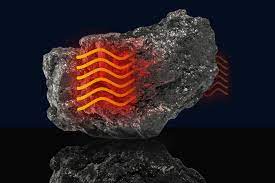
Here, in this case, the kettle remains the warmest spot because as heat is carried away by molecules in the air, these molecules are constantly scattered in every direction, including back toward the kettle. This back-scattering occurs for phonons as well, keeping the original heated region of a solid the warmest spot even as heat diffuses away.
However, in materials that exhibit second sound, this back-scattering is heavily suppressed. The heat stored in the phonons is carried like a wave, and the point that was heated initially is almost instantly cooled at close to the speed of sound.
Discovery
Now coming to the question of how this phenomenon was discovered?
The experiment was inspired by earlier theoretical work by Chen and Sam Huberman while studying the transport of phonons in 2D graphene, which are essentially flat sheets of carbon just an atom thick. They had suggested that the phenomenon of second sound could be observed over a range of temperatures in 3D graphite.
To prove this, researchers at MIT developed an intricate model to numerically simulate the transport of phonons in a sample of graphite. A technique called transient thermal grating was used in which two laser beams were crossed so that the interference of their light generated a ripple pattern on the surface of a small sample of graphite. The regions of the sample underlying the ripple’s crests were heated, while those corresponding to the ripple’s troughs remained unheated.
A third laser beam was shone onto the sample, whose light was diffracted by the ripple, and a photodetector measured its signal. This signal was proportional to the height of the ripple pattern, which depended on how much hotter the crests were than the troughs.
In this way, they kept track of every possible scattering event that could occur with every other phonon, based upon their direction and energy. They ran the simulations over a range of temperatures, from 50 K to room temperature, and found that heat might flow like a second sound at temperatures between 80 and 120K.
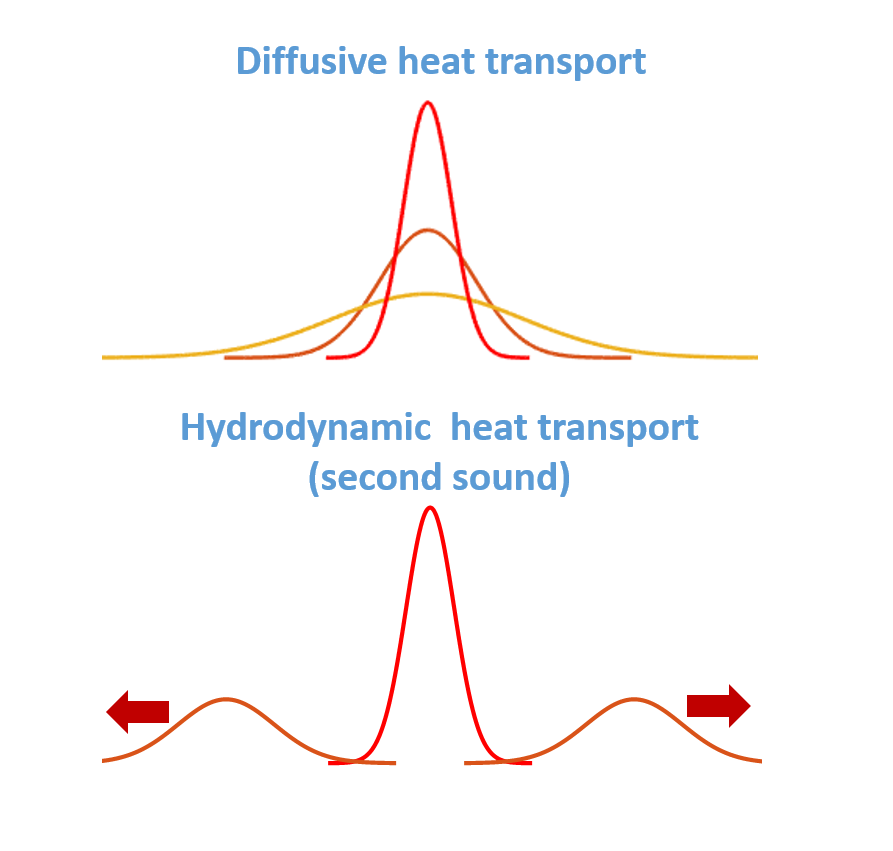
If heat were to flow normally in the sample, the surface ripples would slowly diminish, and the crests would gradually decay to the same level as the troughs as they cooled. But surprisingly, they found that the initially warmed regions that are the crests cooled so rapidly that they became much cooler than the troughs, meaning that for some of the time, heat flowed from cooler regions into warmer regions which are completely contrary to our everyday experience.
This property of heat flow conforming to a wave equation, rather than to the classical diffusive heat flow equation, results in such seemingly paradoxical situations as heat flowing uphill against thermal gradients. This would revolutionize the heat sinking of electronic components.
There’s a huge push to make things smaller and denser for devices like our computers and electronics, and thermal management becomes more difficult at these scales. To conclude, this phenomenon, if observed at room temperature, can be used for practical applications, and so, in the future, graphene may efficiently remove heat in microelectronic devices in a way that was previously unrecognized.
– By Sumanth Hegde, Third Year Department of Mechanical Engineering