WHAT IS A CARBON NANOTUBE?
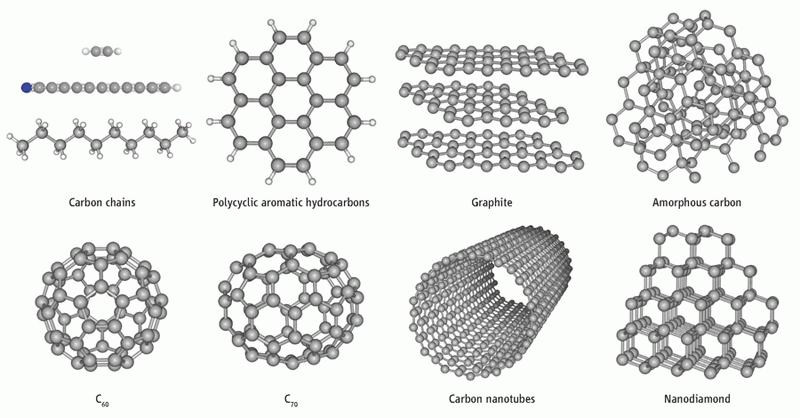
A hundred times stronger than steel yet lighter than Aluminium, Carbon Nanotubes(CNTs) are cylindrical molecules consisting of rolled-up sheets of graphene. They can be single-walled (SWNT) or multi-walled (MWNT). They are one of the strongest materials known to man, yet engineers are just starting to unlock their full potential.
The pictures of Carbon Nanotubes were produced as far back as 1959 by Roger Bacon but only in 1991 did Sumio Iijima understand what they were and coined the term Carbon Nanotubes.
PROPERTIES AND APPLICATIONS
Graphene, the material most closely related to CNT, is a remarkable material in its own right. Like Carbon Nanotubes, it is incredibly strong. The 2010 Nobel Prize in Physics was awarded to the team that first isolated a sheet of graphene, and graphene is so strong that, in theory, a sheet of graphene weighing about one milligram could hold a cat. This “Cat hammock” would be one atom thick and completely invisible to the human eye.
Carbon Nanotubes have very attractive properties such as:
- High electrical and thermal conductivity.
- Very elastic ~18% elongation to failure.
- Very high tensile strength and highly flexible can be bent considerably without damage.
- Low thermal expansion coefficient and are good electron field emitters.
However their size restricts them from being able to be used at an industrial scale, for example, in wires to transport electricity, when travelling in a tube there’s very low resistance but when the current needs to jump from one tube to the next it faces a relatively high amount of resistance which decreases the efficiency of CNTs.
WHY ARE CARBON NANOTUBES SO STRONG
The reason that CNTs even come closer to the theoretical strength of carbon is because they’re small. The theoretical strength of a material is the stress which would be required to break a perfect crystal free from any defects.
The theoretical strength of pure iron is 31.8 GPa, but in reality, bulk steels have strengths in the range of 270-740 MPa, less than 2.5% of the theoretical strength. Bulk materials never get close to their theoretical strengths because, even with extremely careful processing, large-sized materials inevitably end up with microstructural defects that reduce their strength.
This limitation is also the reason that humans are unlikely to ever fabricate a perfect 1 atom thick graphene cat hammock described in the 2010 Nobel Prize award ceremony.
These tiny defects known as dislocations make the bulk steels susceptible to plastic deformation and failure at lower stresses compared to a hypothetical defect-free crystal. And the smaller the size of the material the less chance of there being a defect so the closer it is to theoretical strength.
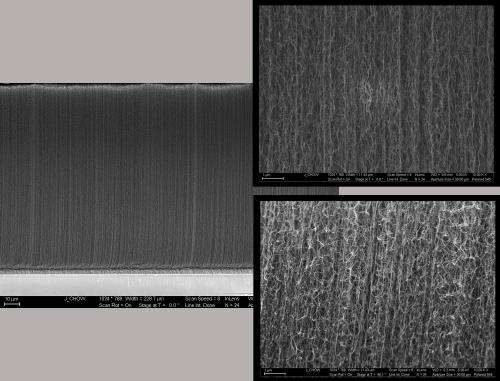
The tiny nanotube is statistically, much more likely to be completely defect-free, and therefore extremely strong. But to bundle up enough nanotubes to create a part of equal size to the steel rod, we would have to create a fibre-reinforced composite.
CHALLENGES IN USING CARBON NANOTUBES
As Carbon Nanotubes are supposed to be perfect, fabricating them to be of any size so that they can be used in industries is a paramount task, something that scientists are still working on.
Researchers have been able to create individual tubes with a length of 50cm but creating a bundle of nanotubes (called a forest) of length over 2cm is a difficult task; the most promising method to industrially manufacture Carbon Nanotubes is by chemical vapour deposition, a gas containing Carbon, like Methane is used to extract Carbon and Hydrogen is vented out to prevent an explosion, the longest Carbon Nanotube produced by this method was made in Japan last year and its length was 15cm, more than 7 times the length that can commonly be produced.
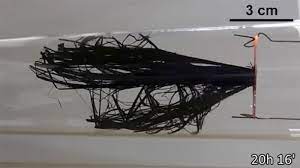
Slowly but surely, we are getting closer to unlocking the potential of this almost magical material. Maybe one day we will have extremely long battery life for our devices, extremely light but stronger aircraft bodies at a cost similar to the current bulk materials, as the tech trickles down the cost too will come down. In this article, I’ve just scratched the surface of CNT as a material and its strengths and shortcomings. There’s still so much untapped potential that I hope we can unlock in the near future.
– By Annie Rajvanshi, Third Year Department of Mechanical Engineering