With the increase in Global Warming due to various human activities, burning gasoline for the purpose of transportation is one of the leading factors. Due to this, Electric Vehicles (EVs) are gaining traction as a sustainable transportation solutions for several reasons, including reducing carbon emissions, improving air quality, and saving money on fuel and maintenance.
Out of the mentioned benefits of EVs, the ability they possess to reduce carbon emissions gives us more incentive to explore and develop this technology behind it. Traditional vehicles that run on gasoline emit harmful greenhouse gases that contribute to climate change. EVs, on the other hand, do not produce any emissions while driving, as they run on electricity. This electricity can come from multiple renewable energy sources like wind or solar power, further reducing our dependency on fossil fuels. By switching to EVs, we are reducing our carbon footprint, improving air quality, and therefore undoubtedly making a positive impact on our planet.
In the early 21st century, there was a renewed interest in electric vehicles as concerns about climate change and oil dependence grew, which resulted in the modern Electric Motor.
The motor consists of 2 main parts: the stator and the rotor. The stator is the stationary part of the motor, consisting of a series of coils of wire. These are energized with electricity, which creates a magnetic field. While the rotor is the moving part of the motor, and it consists of a series of magnets. The magnetic field from the stator interacts with the magnets on the rotor, causing it to rotate. The speed and direction of the rotor are controlled by the flow of electricity to the stator coils.
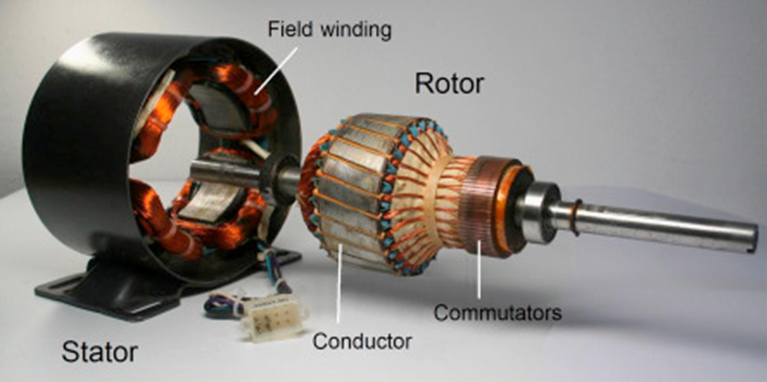
As the rotor rotates, it cuts through the magnetic field, causing a voltage to be induced in the rotor. This voltage creates a current, which creates a magnetic field in the rotor. The interaction between the magnetic field created by the stator and the magnetic field created by the rotor causes the rotor to rotate. The efficiency of an electric motor depends on several factors:
- Quality of materials used
- Control system used to regulate the flow of electricity to the stator coil
After seeing how the motor works, two types of electric motors are used to create traction for the vehicle. Those two are:
- Asynchronous (aka induction)
- Synchronous
In an asynchronous, or induction, motor, the rotor is pulled into a spin, constantly trying to “catch up” with the rotating magnetic field created by the stator. This type of electric car motor is known for its high-power output and is a common motor in vehicles.
In a synchronous motor, on the other hand, the rotor turns at the same speed as the magnetic field. This provides high torque at low speed, making it ideal for urban driving. Another advantage is its size: a synchronous electric car motor can be compact and low in weight.

In an electric car, the electric motor is just one part of a larger unit called the powertrain. Here we also find the Power Electronic Controller (PEC), in charge of the electronics that control the motor’s power supply and battery charging, and the gear motor, which adjusts the torque (turning force) and speed of rotation.
Constructing the different elements of an EV motor requires real expertise. At Renault, supervisor Tatiana Sueur explains, “To build a stator, for example, we had to find how to wind 2 kilometers of copper wire into little notches in sheet metal without damaging the insulating ceramic that covers them.”
Powertrain efficiency is constantly being improved, Renault’s ZEO (Renault’s all-electric automobile) being the perfect example in which technological innovations can be seen, leading to better all-around vehicle performance and introducing more features.

As we have seen, the technology behind EVs is the key to decarbonizing road transport, a sector that accounts for 16% of global emissions. Between 2012 – 2021, around 17 million electric vehicles were sold worldwide, which is expected to reach a booming 145 million by 2030.
Overall, electric vehicles have proven to provide numerous advantages. As technology continues to advance and battery costs continue to decline, it is most likely that EVs will become more abundant and the way of the future.
~ Akarsh Gupta, Second Year of Department of Electrical and Electronics Engineering